Excerpt from Mildred Phelps Stokes Hooker, Camp Chronicles (privately printed, 1963), pp. 7–13
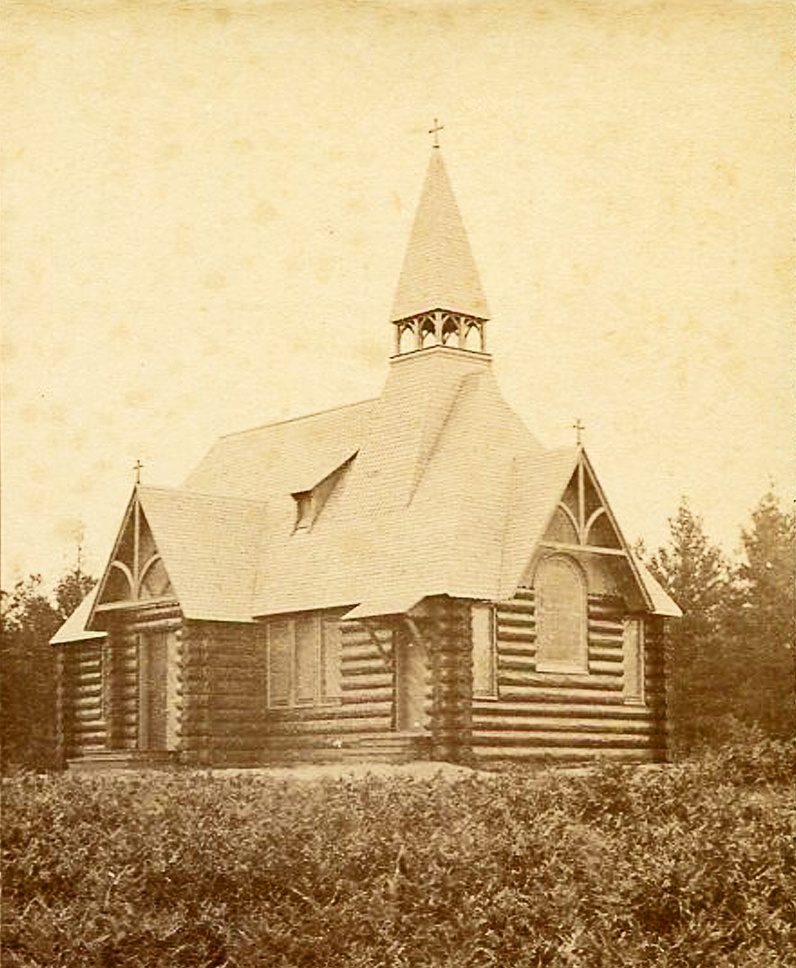
Mother speaks of walking from the hotel [Paul Smiths] to the little church of “St John’s in the Wilderness.” This was the little log church which we all loved so much, which burned down in 1927.
We can be grateful to Dr. Trudeau for our church as well as for so many other things. During their first winter at the hotel, he and Mrs. Trudeau had greatly missed church and worried so much because there were no services available to the guides and their families that he himself held a Sunday School in the little school house on the road to Blooimingdale so as to do something, to quote his own words, “to carry the blessed message to those children who had so little opportunity to hear it.”
For a while services were held occasionally in the hotel parlors, but by the fall of 1876 Dr. Trudeau had started a subscription list for “a little log chapel,” and Mrs. Louis Livingstone, who was one of those he appealed to, got him off to a good start by giving a fair in her New York home which brought in fourteen hundred dollars. Paul Smith gave the land and logs.
The little chapel was consecrated by Bishop Doane on September 13, 1877. It soon outgrew its seating capacity and had to be enlarged. Again it was Dr. Trudeau who raised the necessary funds.
He was warden of the little church all his life, and how well I remember him carrying the collection plate to the altar in his fascinating high leggings with my father by his side. I think it was because Dr. Trudeau and my father always took up the collection that the custom grew up of having them sitting the two front pews. It made it easy for them to step out together.
St. John’s played an important role in camp life. We were always a church-going community, and it was a gay and lovely sight on sunny Sunday mornings to see the long line of rowboats with flags fluttering at bow and stern wending its way down through the “sleuths” to church. Gayest of all was a boat from the Livingstone camp with white paint and red cushions.
Even sailboats joined in the parade. Father used to say that though he didn’t, of course, approve of Sunday racing, it was quite another matter to take two boats and see who get to church first! He was happiest when he had the minister on board for then he couldn’t possibly be late for service, and this was a privilege he often enjoyed for Sunday morning preachers were usually our Satturdaynight guests. In fact, we used to call one of our cabins “The Rectory” or “The Prophet’s Chamber” because our ministers used it so often.
In those day one ministers ministered to a host of little missions in the neighborhood. Lr. Larom, who held services at St. Joh’s for years, was known as “The Bishop of all Outdoors.” He did a good deal of his traveling in a canoe with a two-bladed paddle, and when he arrived early enough on Saturdays he would hoist a little sail and join in the afternoon boat race. It was really very sporting of him for him in spite of his handicap allowances, he always came in way behind everyone else. Being dependent on his own power, so to speak, there were times when bad weather or other emergencies prevented his getting here at all. But this didn’t prevent our holding services. We would just dispense with the sermon and one of my brothers would step out of our pew and read the lessons.
My brothers were not the only laymen to officiate in our little church. Years later when Bishop Brent was making his annual visit to the Reids, he developed a high fever. Ransom, called in to see him, said he must stay in bed, but this the bishop refused to do on account of the services. At least Bishop Brent said he would stay in bed on just one condition, if Random would hold the services. He reluctantly agreed but stipulated that he would not be expected to preach.
This was after our log church had burned, which it did just as we had celebrated its fiftieth anniversary.
Ranoms was Chairman of the Committee for rebuilding and wanted to build a church of logs just like the old one, but there were more, including two large subscribers, who felt that permanent material should be used, so he bowed to their wishes. I think Mr. Distin, the architect, was very successful in keeping so much of the spirit of the old church, even though stone was used instead of logs.
There was quite a question about the windows too. Some of us wanted to use gothic tracery and clear glass so that we could look out at the pines and Dr. Trudeau’s grave, but here again the m majority preferred stained glass. Mrs. Whitelaw Reid used the clinching argument that someone would surely put in stained glass someday anyways, and then it would be too late for us to make sure that they were harmonious in color and design. She quite convinced us by taking us to see a church near Purchase where enormous prophets and smaller subjects were jumbled up with flower windows from Tiffany Studios to the detriment of all.
Churchgoing entails d a walk as well as a row. We used to land at the hotel docks and walk up either by the board walk bordering the road or by the path on the other side of the “ice pond.” For the very first years there was only the path, but when in no hurry we much preferred it anyways for it led through a lovely grove of pine trees and past an Indian camp. The only trouble was that being a Sunday we weren’t allowed to buy the sweet grass baskets and moccasins and little birch bark canoes that the Indians sold. However, they always made the rounds of the camps once in the season in a big boat filled with their wares, so we didn’t feel too badly.
Once arrived at church we all refreshed ourselves by drinking from the water cooler that stood in the entry. Evidently, like Dr. Loomis, we didn’t believe in germs for we all shared a single glass!
 St. John's in the Wilderness, Paul Smiths